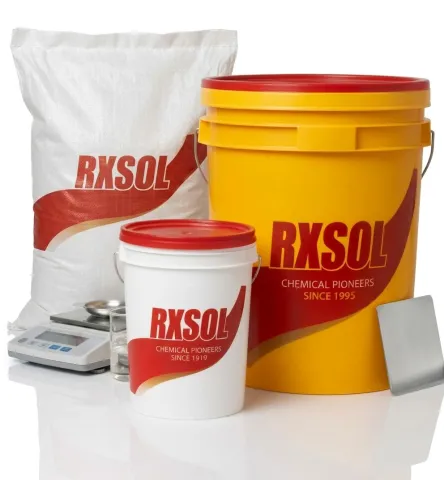
CAT Sulphite 25 Ltr
RXSOL-50-5008-025 is a Liquid sludge conditioner designed to prevent deposits and most common Boiler water treatment chemicals..DOSES : The initial dosage is 20 ml of treatment daily for every ton of boiler capacity. Bottom blow down is required daily when using Boiler Coagulant.
RXSOL-50-5008-025 Boiler Coagulant prevents the formation of deposits on boiler internal surfaces. Sludge is kept dispersed in small particles and conditioned to be removed normal blow down. In this way tube over heating due to deposits is avoided.
Oxygen Control
Chemical Oxygen Scavengers. The oxygen scavengers most commonly used in boiler systems are sodium sulfite, sodium bisulfite, hydrazine, catalyzed versions of the sulfites and hydrazine, and organic oxygen scavengers, such as hydroquinone and ascorbate.
It is of critical importance to select and properly use the best chemical oxygen scavenger for a given system. Major factors that determine the best oxygen scavenger for a particular application include reaction speed, residence time in the system, operating temperature and pressure, and feedwater pH. Interferences with the scavenger/oxygen reaction, decomposition products, and reactions with metals in the system are also important factors. Other contributing factors include the use of feedwater for attemperation, the presence of economizers in the system, and the end use of the steam. Chemical oxygen scavengers should be fed to allow ample time for the scavenger/oxygen reaction to occur. The deaerator storage system and the feedwater storage tank are commonly used feed points.
In boilers operating below 1,000 psig, sodium sulfite and a concentrated liquid solution of catalyzed sodium bisulfite are the most commonly used materials for chemical deaeration due to low cost and ease of handling and testing. The oxygen scavenging property of sodium sulfite is illustrated by the following reaction:
| 2Na2SO3 | + | O2 | ® | 2Na2SO4 |
| sodium sulfite | oxygen |
sodium sulfate |
Dosage
Theoretically, 7.88 ppm of chemically pure sodium sulfite is required to remove 1.0 ppm of dissolved oxygen. However, due to the use of technical grades of sodium sulfite, combined with handling and blowdown losses during normal plant operation, approximately 10 lb of sodium sulfite per pound of oxygen is usually required. The concentration of excess sulfite maintained in the feedwater or boiler water also affects the sulfite requirement.
Sodium sulfite must be fed continuously for maximum oxygen removal. Usually, the most suitable point of application is the drop leg between the deaerator and the storage compartment. Where hot process softeners are followed by hot zeolite units, an additional feed is recommended at the filter effluent of the hot process units (prior to the zeolite softeners) to protect the ion exchange resin and softener shells.
As with any oxygen scavenging reaction, many factors affect the speed of the sulfite-oxygen reaction. These factors include temperature, pH, initial concentration of oxygen scavenger, initial concentration of dissolved oxygen, and catalytic or inhibiting effects. The most important factor is temperature. As temperature increases, reaction time decreases; in general, every 18°F increase in temperature doubles reaction speed. At temperatures of 212°F and above, the reaction is rapid. Overfeed of sodium sulfite also increases reaction rate. The reaction proceeds most rapidly at pH values in the range of 8.5-10.0.
Remarks
Supply Locations
CAT Sulphite manufacturer supplier distributor in Mumbai, Kandla, Kolkata, Vizag, Chennai, India, Fujairah, Dubai UAE, Muscat Oman, Kenya Africa. Get the best quality of CAT Sulphite at a competitive price from us. We have ready stock of CAT Sulphite in India, UAE Gulf, Oman, Kenya Africa. Contact us for bulk as well as small orders.